
MANIFESTO
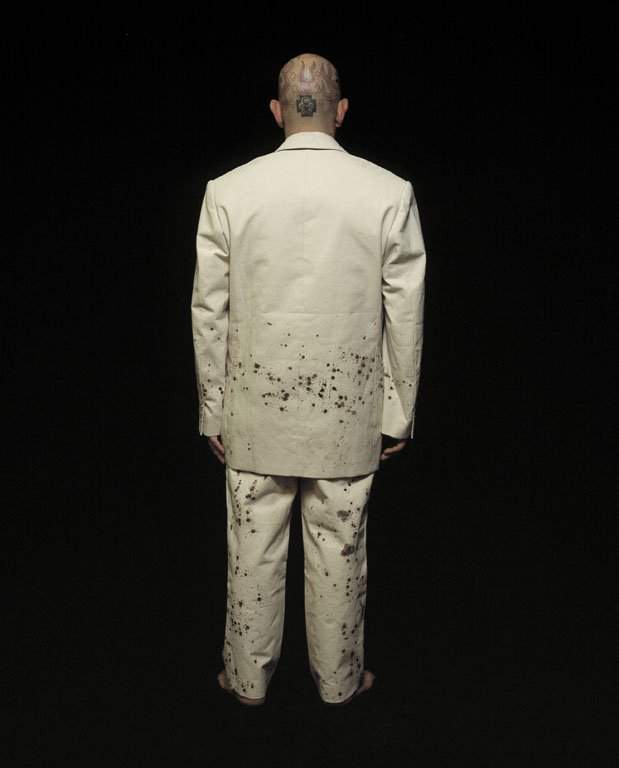 Source: Franko B — Haute Couture
Introduction
This text arises from the need to give form to an articulated line of reasoning that cannot be reduced to slogans or identity positioning. R3WEAR emerges at a precise point in the history of contemporary fashion, when certain dynamics that were functional for a long time encounter a structural limit.
To address this issue, several levels must be held together: the history of European fashion, its intrinsic relationship with time, the social changes that have guided its evolution, and the emergence of sustainability as a historical and material question. R3WEAR positions itself within this intersection, without presenting itself as an exception or an external break.
In developing this path, the text draws on a number of established critical perspectives. In particular, the view of fashion as a form of high-level functional craftsmanship, distinct from art precisely because of its necessary relationship with use and with the body, is consistent with a tradition of thought widespread in Italian design culture and with Giorgina Siviero’s reflections on fashion as a situated cultural practice. Although this position is not universally shared in theoretical debate, it is supported by a substantial part of European fashion historiography.
Likewise, the reading of the transition from haute couture to prêt-à-porter as a response to changes in the rhythms of everyday life, particularly in the social and working role of women after the Second World War, is widely documented in the historical and sociological literature on fashion. This is not a retrospective simplification, but an interpretative key that makes it possible to read fashion as a device for adapting to changing times.
This text therefore adopts a precise method: wherever possible, each statement is linked to a recognisable historical or theoretical basis; where this is not possible, it is treated as a situated interpretation, implicitly declaring its status. Within this framework, R3WEAR takes shape as a functional response to a real transformation in the cycles of fashion and consumption.
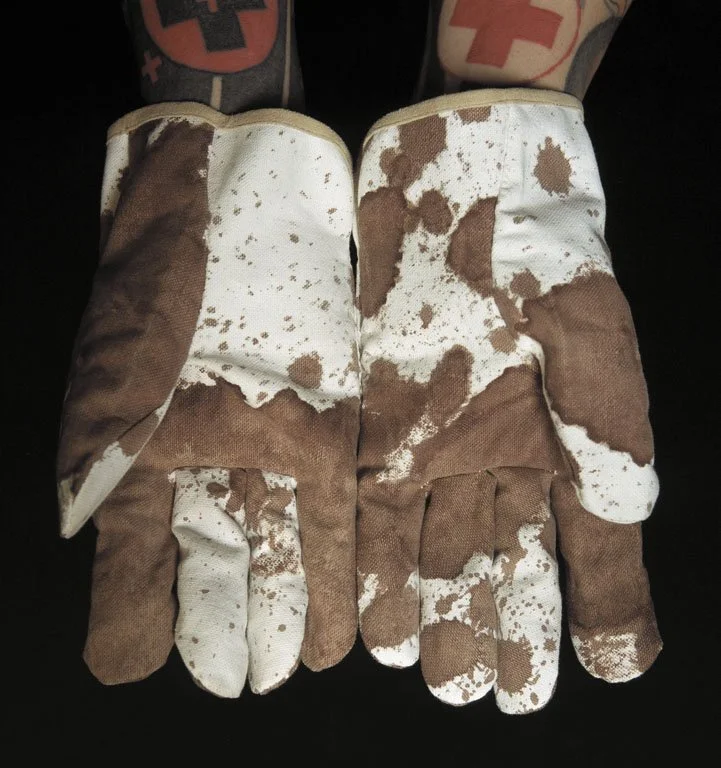
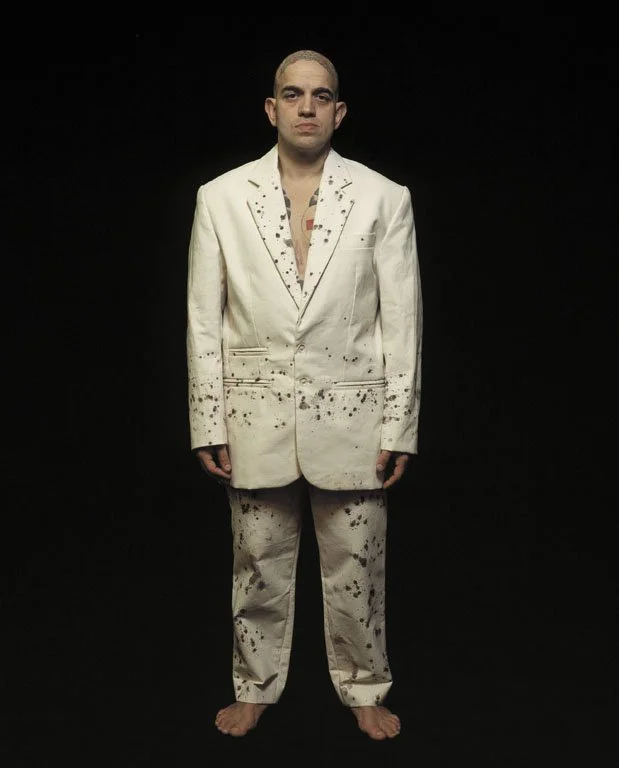
Image source: Franko B — Haute Couture. Photographs by Manuel Vason and Franko B.
Fashion and time: a structural relationship
From its modern origins, fashion defines itself as a temporal practice. Unlike art, which can withdraw from use and function, clothing maintains a direct relationship with the body and with everyday life. This relationship necessarily exposes fashion to time, to its changes and to its accelerations.
As Giorgina Siviero observes, fashion affirms and negates within the span of a season. This oscillation is not a flaw in the system but its fundamental mechanism. Fashion does not promise stability, but relevance: being appropriate to a moment, a context and a social configuration.
Historically, this temporal structure has been articulated through different regimes. Haute couture, which developed between the late nineteenth century and the first half of the twentieth century, operated within a long timeframe made of waiting, successive fittings and a direct relationship between creator and body. The value of a garment was linked as much to its material as to the time embodied in its making.
Prêt-à-porter gradually asserted itself after the Second World War, in parallel with increased social mobility, the mass entry of women into paid work and the transformation of urban rhythms. Its rise cannot be read simply as a democratisation of luxury, but as a concrete response to a new organisation of everyday time. This interpretation is consistent with numerous studies on the history of European fashion and dress.
In the 1970s and 1980s, high-quality industrial serial production introduced a further acceleration, accompanied by intense research into materials and forms. The deconstructed suit, associated in particular with the work of Giorgio Armani, is often interpreted as the expression of a new female subjectivity, more autonomous and more central within professional life. This reading, widespread in fashion criticism and historiography, is supported by the socio-economic context of the period, marked by a redefinition of gender roles and the expansion of women’s clerical and managerial work.
Across these transitions, the speed of fashion responds to a transformation in social time. Acceleration acquires meaning because it translates a real change in the ways people live, work and inhabit the body.
Acceleration, the 1980s and the transformation of fashion time
The 1980s represent a point of theoretical concentration in the relationship between fashion and time. Reducing the decade to a superficial image of excess or spectacle means missing the structural nature of what happened. In that historical passage, the acceleration of fashion is not an accident but the coherent expression of a broader transformation of capitalism, work and subjectivity.
Within the European context, and particularly in Italy, 1980s fashion developed alongside the crisis of the Fordist model and the spread of more flexible, immaterial and image-oriented forms of work. Sociological studies such as those by Boltanski and Chiapello have shown how, during this period, capitalism incorporated artistic and cultural critique, turning creativity, autonomy and lifestyle into productive resources. Clothing became one of the principal tools through which this transformation was made visible and practicable.
Within this framework, the emergence of a highly recognisable, branded, serial yet differentiating fashion should not be read as a loss of cultural depth. Clothing takes on the function of a social positioning device: it enables the body to occupy new spaces, sustain new postures and legitimise new roles. Deconstructed professional clothing, associated with the work of Giorgio Armani, sits precisely at this junction, translating into dress a female subjectivity that enters the spaces of economic and decision-making power on a stable basis.
The speed with which collections follow and replace one another still maintains, at this stage, a recognisable relationship with historical time. Acceleration responds to a multiplication of social occasions, greater public exposure of individuals and increasing symbolic competition. Fashion continues to operate as a language capable of registering differences and producing meaning.
It is, however, in the same period that a subtler transformation begins to emerge. Alongside historical time, linked to identifiable social changes, an increasingly autonomous operational time takes shape. The production and distribution of clothing begin to be governed by logics of optimisation, rapid turnover and market saturation. This shift is not immediately perceptible on an aesthetic level, but it progressively alters the internal functioning of the fashion system. In the following years, this operational time tends to emancipate itself from historical time. Acceleration ceases to be a response to transformations in social life and becomes an internal requirement of the productive system. Seasons multiply, collections progressively lose their distinctive capacity, and negation no longer produces difference but repetition. In this passage, fashion time increasingly approaches logistical time, oriented towards managing flows rather than producing meaning.
This shift marks a turning point. When acceleration is no longer sustained by a real transformation of bodies and social roles, fashion loses part of its interpretative function. Clothing continues to circulate, but struggles to inscribe itself within a recognisable historical narrative. It is in this zone of indeterminacy that the first tensions begin to emerge, still in fragmentary form, that will bring sustainability to the centre of debate.
The relevance of the 1980s, therefore, lies not only in the intensification of speed, but in the fact that they constitute the moment when fashion time begins to split in two. On the one hand, a historical time persists, capable of producing forms and languages. On the other, an autonomous time asserts itself, oriented towards the continuity of productive flow. The fracture between these two temporal regimes is not immediate, but prepares the ground for subsequent transformations in the fashion system.
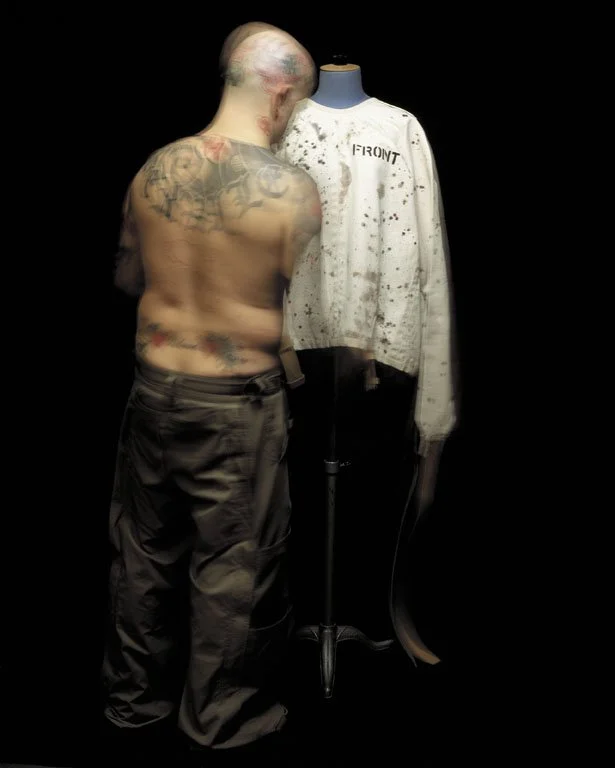
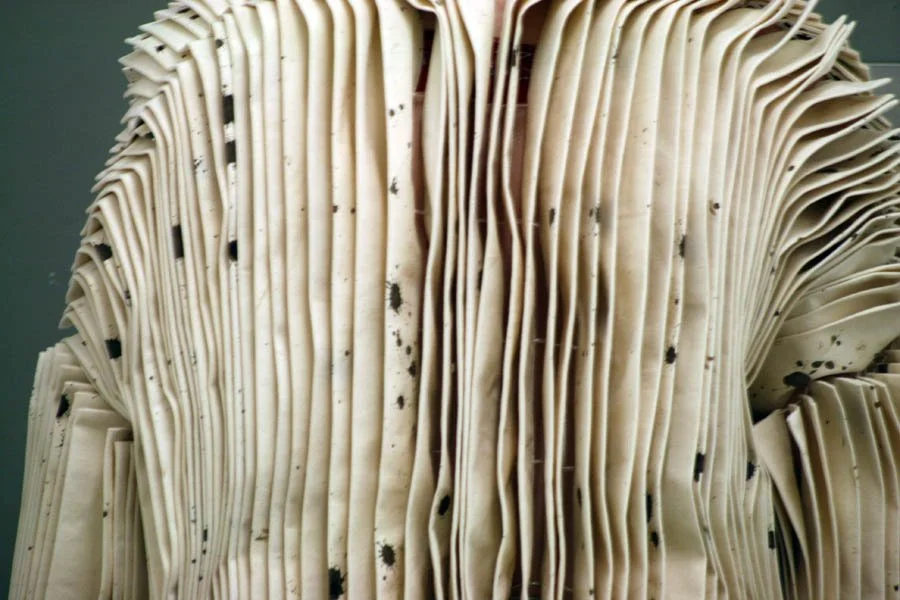
Image source: Franko B — Haute Couture. Photographs by Manuel Vason and Franko B.
From historical time to logistical time: fast fashion and the breakdown of the cycle
The transition from historical time to logistical time finds its fullest expression in the model that, from the 1990s and especially in the early 2000s, came to be defined as fast fashion. Here too, a moralistic or merely accusatory reading risks obscuring the structural nature of the phenomenon.
Fast fashion does not arise as an anomaly external to the fashion system, but as the coherent outcome of processes already underway: the globalisation of production chains, the financialisation of companies, just-in-time optimisation of supply chains and the growing centrality of sales data in the management of collections. Studies of the fashion economy show how the primary objective progressively became reducing the time between design, production and distribution, until speed itself became a decisive competitive parameter.
In this configuration, time is no longer the language through which fashion interprets recognisable social changes. It becomes a technical variable, measurable and compressible. Seasons multiply, collections fragment, and formal differences tend to diminish. Negation, which in historical fashion produced rupture and innovation, takes the form of accelerated repetition.
This shift has significant functional consequences. Clothing progressively loses the capacity to accompany transformations of the body and of social roles. It is designed for a short life in use, often independently of material quality or constructional care. The relationship between the wearer and what is worn weakens until it becomes purely transitory.
From a systemic point of view, fast fashion introduces a break in the fashion cycle. Under previous regimes, a garment passed through a recognisable sequence: design, production, use, disposal, and sometimes reuse or transformation. In the new model, the disposal phase is accelerated and made opaque. Once its commercial function is exhausted, the garment’s fate disappears from the system’s field of vision.
It is at this point that the tensions making sustainability a historical issue accumulate. The exponential increase in production volumes, the intensive use of synthetic fibres derived from fossil sources, and the compression of labour time and costs along the supply chain generate environmental and social impacts that can no longer be treated as marginal externalities. The literature on so-called planetary boundaries has shown that these limits are not negotiable at the material level.
Sustainability therefore emerges as the effect of systemic saturation. It does not introduce new values into the fashion system, but makes its constraints visible. As in other industrial sectors, the problem lies not in production itself, but in the management of the product’s overall life cycle.
Within this framework, many of the responses adopted by the fashion system remain partial. Recycled materials, environmental certifications and informational labels address needs for transparency, but do not intervene in the temporal structure of consumption. As studies of everyday practices have shown, more information does not automatically translate into changed behaviour.
The breakdown of the cycle, produced by the predominance of logistical time, leaves open a functional space that the fashion system struggles to address. It is in this space that devices concerned with managing the after are located: after the sale, after use, after the garment’s first life. The relevance of these devices does not depend on an ethical judgement of fashion, but on the need to reconstruct passages that the system has made invisible.
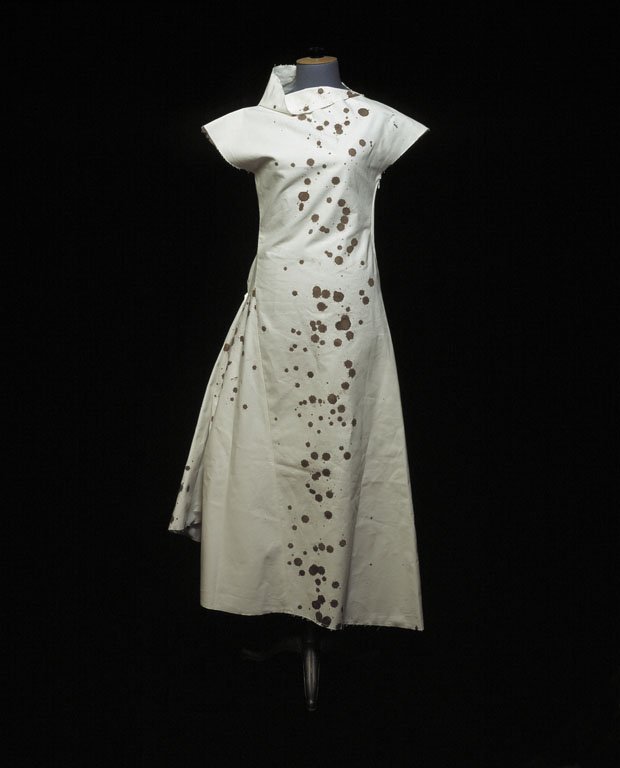
Image source: Franko B — Haute Couture. Photographs by Manuel Vason and Franko B.
Decision, practices and the limits of the information model
The centrality of sustainability in contemporary debate has produced, especially since the 2000s, a proliferation of informational tools: environmental labels, certifications, awareness campaigns and impact indicators. These devices share a common assumption: that increasing the information available leads to more conscious decisions and, consequently, more sustainable behaviour.
In the essay Beyond the ABC: Climate Change Policy and Theories of Social Change (2010), Elizabeth Shove radically questions this assumption. The ABC model — Attitudes, Behaviour, Choice — assumes that change occurs by modifying individual attitudes, which in turn would guide rational choices. According to Shove, this model fails because it treats behaviour as the expression of isolated individual intentions, ignoring the role of social practices and material contexts.
Shove’s critique is not about a lack of information, but about its structural ineffectiveness. Numerous studies show that environmental awareness has steadily increased in recent decades without a proportional reduction in overall impacts. This gap does not arise from a moral contradiction within individuals, but from the fact that everyday practices are organised by infrastructures, social conventions and shared expectations that exceed individual will.
Applied to the fashion system, this perspective clarifies a crucial point. Most of the decisions that determine the environmental impact of a garment do not occur at the moment of purchase, but along a sequence of practices: use, maintenance, repair, accumulation and disposal. These practices are governed primarily not by information or declared values, but by habits, available time, learned skills and concrete possibilities for action.
The information model tends to focus on the moment of the initial choice, overloading it with symbolic responsibility. In this way, sustainability is reduced to a one-off act, while the garment’s life cycle remains without tools of governance. Environmental labels can make certain aspects of production visible, but they do not provide spaces or occasions in which to exercise a decision over the time of use.
Shove proposes shifting attention from individual choices to social practices. Practices are relatively stable configurations of materials, competences and meanings. Changing a practice means intervening in one or more of these elements, not simply changing intentions. In fashion, this means questioning the conditions that make rapid accumulation, perceived obsolescence and automatic disposal of clothing normal.
From this perspective, decision is not an abstract act but a situated competence. Deciding that a garment should remain, be transformed or be entrusted to someone else requires time, context and social recognition. Without spaces that make this decision practicable, the system’s automatism tends to prevail.
Shove’s contribution therefore helps explain why many sustainability policies in fashion produce limited results. They act upstream, at the level of information and intentions, leaving intact the void that opens downstream, in the management of what comes after. It is within this void that the need arises for devices capable of making decisions observable, practicable and shared when today they remain private or entirely absent.
R3WEAR as a device for moving through the cycle
At this point in the argument it becomes possible to name R3WEAR’s function explicitly. It takes shape at a precise point in the contemporary fashion cycle, when logistical time has made the fate of garments after use opaque, while its effects do not remain confined exclusively to the downstream side of consumption.
Under the fast-fashion regime, the design–production–sale sequence is governed with extreme precision, while the phase that follows remains without structures of meaning. Once its immediate commercial or symbolic function is exhausted, a garment tends to slide towards accumulation or expulsion. This passage is processed neither culturally nor operationally. R3WEAR intervenes in this gap by introducing a threshold that makes the transition visible and practicable.
R3WEAR operates as a device for moving through the cycle, but also as a device of temporal resonance. It acts at the moment when a garment loses its active status in a person’s wardrobe and risks becoming an inert object, while at the same time producing effects that reverberate through future choices. The decision made about the fate of a garment modifies the perception of fashion time as a whole.
The threshold introduced by R3WEAR is not prescriptive but practical. It consists in making observable a decision that would normally remain implicit or automatic: deciding whether a garment still deserves time. This decision concerns the relationship between garment, body and life context, and cannot be reduced to the material evaluation of the object.
In this sense, R3WEAR intervenes primarily downstream of the fashion system, but does not remain confined there. The experience of entrusting, reusing and transforming a garment introduces an operational memory that affects subsequent practices. After going through a real decision, the act of purchasing cannot recur as a purely amnesic gesture. Future choices are implicitly measured against the time a garment will require, not only against its immediate value.
The reversibility of entrustment is a central element. Entrusting a garment is neither a definitive transfer nor a simple act of disposal. It keeps open the possibility of another life in use, placing that possibility in a different context. In this way, the garment is not removed from time but reinscribed within a different temporal sequence.
Within this device, upcycling has a specific function. It is not treated as a technique for recovering materials, but as a practice of symbolic reactivation. Through transformation, a garment overwhelmed by dominant fashion regains the ability to say something about the person who wears it. Visible modification interrupts serial anonymity and reinscribes the garment within a biography, restoring one of fashion’s historical functions: self-declaration.
Historically, fashion has always operated as a language of positioning and belonging. Under accelerated production, this function tends to empty out because the declaration is standardised and made interchangeable. In this context, upcycling is not a return to craftsmanship, but a reclaiming of symbolic agency. It makes a choice legible, produces discontinuity and introduces difference.
From the perspective of practices, R3WEAR alters the configuration of decisions in a minimal but decisive way. It transforms a private, silent choice into a situated and recognised gesture, and through that transformation makes decision-making practicable and learnable. In continuity with Shove’s reflections, the device does not aim to change abstract attitudes, but to intervene in practices by providing a space, a time and a grammar within which a decision can take place.
R3WEAR’s function becomes clear as a response to a structural absence in the contemporary fashion system. Where the cycle breaks, the device introduces a threshold; where time becomes purely operational, it introduces a time for decision; where self-declaration is neutralised, it reactivates a possibility of expression. This function does not claim to resolve the complexity of the fashion system, but works precisely on a critical segment of its operation.
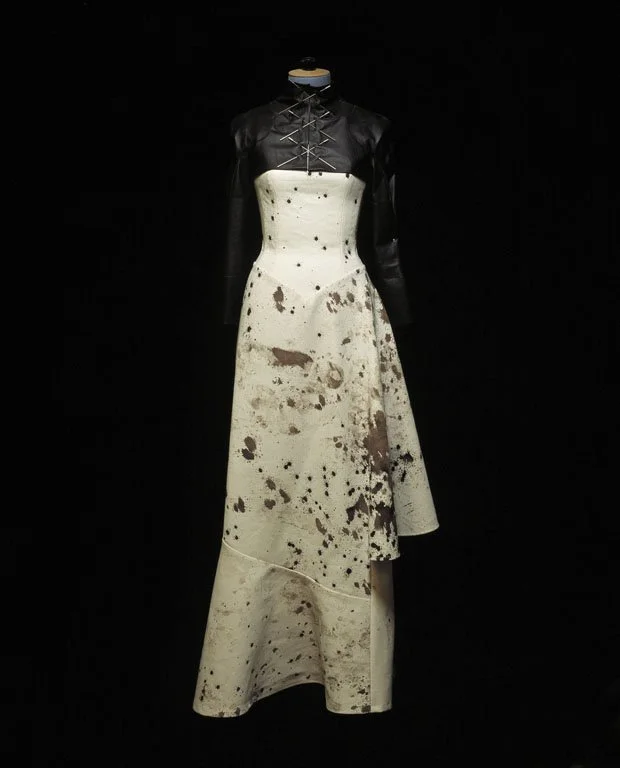
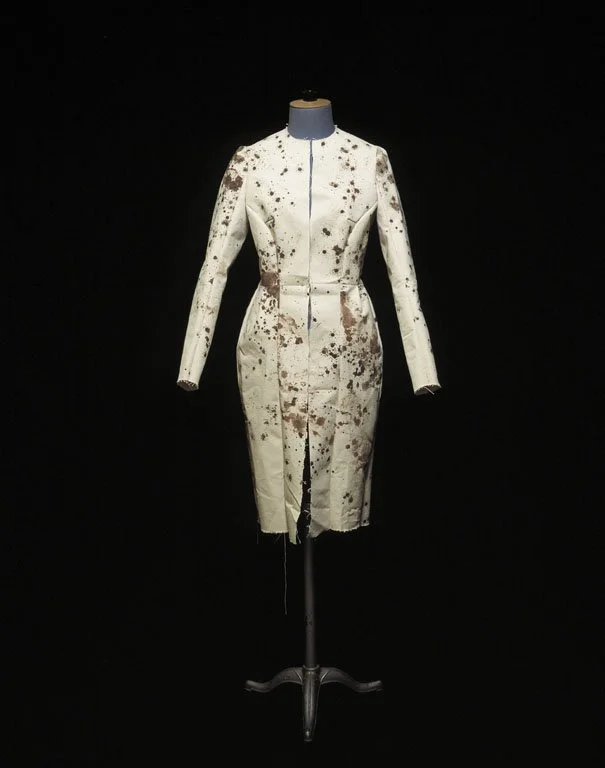
Image source: Franko B — Haute Couture. Photographs by Manuel Vason and Franko B.
Transmission and public space: training, Open Collection, situated learning
The path developed so far makes clear that R3WEAR’s operation is not exhausted by managing the garment cycle, nor by producing indirect effects on future choices. For such effects to stabilise and become shareable, a further step is required: the transmission of practices.
Transmission does not concern informational content or rules of behaviour. As the critique of the information model has shown, sustainability is not learned through the accumulation of data or prescriptions. What can be transmitted are situated competences: ways of observing, evaluating and deciding that take shape through experience.
In this sense, the presence of a training organisation within R3WEAR serves a precise function. It does not introduce external knowledge, but makes observable and articulable a process that would otherwise remain implicit. Training intervenes as a practice of translation: it translates a gesture into competence and an experience into shareable knowledge.
The Scuole Tecniche San Carlo occupy this space through their specific vocation for technical and vocational training. Their presence is not didactic in the traditional sense, but ensures that what happens can be recognised as learning. Students encounter real situations, concrete constraints and non-simulated decisions as an integral part of a device in which they act as ambassadors of a “rediscovered” knowledge and, at the same time, as recipients of an intergenerational transmission of the memory of competence. In this context, sustainability appears not as an abstract value but as the outcome of a practice.
The Open Collection is the place where this transmission acquires a public dimension. It is not an exhibition, nor an exhibition event in the conventional sense. The Open Collection is a space for collectively exercising decision-making, where the fate of garments is discussed, entrusted and reactivated in front of others.
In the ritual of entrustment, the individual decision is removed from the private sphere and made visible. This passage produces a dual effect. On the one hand, it allows the individual to recognise their gesture as an act endowed with meaning. On the other, it offers others the possibility to observe, learn and engage with a practice that normally remains invisible. The public dimension does not introduce spectacle but recognition. The decision is not judged according to external criteria; it acquires legitimacy precisely because it takes place in a shared context. In this way, the Open Collection functions as cultural infrastructure: it does not impose behaviours, but makes alternatives to automatism practicable.
In continuity with theories of situated learning, transmission occurs through participation and observation, not through instruction. Anyone taking part in R3WEAR, even without exchanging a garment, comes into contact with a grammar of decision that can be reactivated elsewhere, in other contexts of life.
Training, public space and the device therefore hold together. R3WEAR becomes an environment in which fashion time, use time and decision time can meet without being reduced to a scheme. Sustainability emerges as an effect of this reconfiguration, not as a declared objective.
Within this framework, R3WEAR’s function becomes fully clear. It does not offer generalisable solutions, but makes available an infrastructure for learning and decision-making. Its effectiveness does not depend on scale, but on its capacity to make visible and transmissible practices that the fashion system tends to leave at the margins.